Every parent researching safe sports for kids eventually lands on the same question: how do I give my child the benefits of competitive athletics without the injury risk that keeps me up at night?
It’s a fair question. ACL tears, concussions, and overuse injuries all show up in youth sports, and parents are right to take them seriously.
Fencing answers it two ways: with published data from USA Fencing, and with how the sport itself is built.
The Safety Data
USA Fencing’s Data Resource Team analyzed Fencing Time Live results from August 2019 to July 2025, covering more than 637,000 direct elimination bouts fenced by 44,527 competitors. A fencer withdrew for medical reasons in 0.338% of those bouts, about 1 in every 296 (USA Fencing, 2026).
That count is broad. A medical withdrawal covers illness, dehydration, cramps, and pre-existing conditions as well as injuries, so withdrawals caused by injury are a subset of it. Only 3.9% of the fencers had even one medical withdrawal across all six seasons.
Epee, the weapon we teach, had the lowest rate of the three weapons at 0.261%. The youngest competitors had some of the lowest rates of any group, and Y8 events recorded 0.102%, about 1 in every 978 bouts. USA Fencing published the results under the headline “Fencing Remains One of the Safest Combat Sports.”
Fencing has no tackling, no checking, and no full-speed collisions. Any sport played at speed still carries some head-injury risk, and fencing is no exception.
Why Fencing Is So Safe
The numbers aren’t accidental. Fencing’s safety profile is a product of deliberate design:
Full Protective Equipment
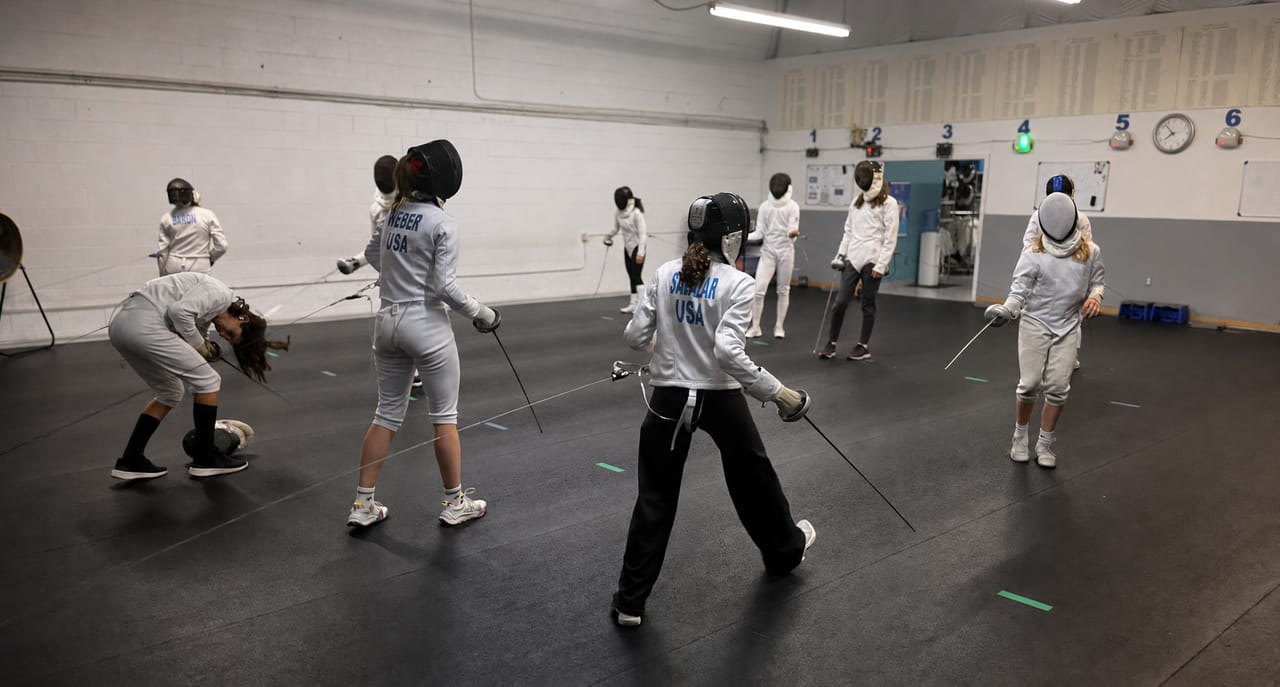
Fencers wear head-to-hand protection during every bout and practice:
- Mask. A steel mesh mask protects the entire head and face.
- Jacket and underarm protector (plastron). Multiple layers of puncture-resistant fabric cover the torso and sword arm.
- Glove. A reinforced glove protects the weapon hand.
- Chest protector. Additional protection for the chest area.
The equipment is specifically engineered to prevent injury. This isn’t optional. It’s required for every minute of every session.
No Collisions, No Contact
Fencing is a non-contact sport. Fencers maintain distance and score by touching their opponent with the tip of a flexible weapon. There is no tackling, no checking, no sliding, and no heading.
Controlled Environment
Fencing takes place on a defined strip (14 meters long, 1.5-2 meters wide) in an indoor, climate-controlled facility. There are no uneven fields, no weather conditions, no goals to crash into, and no random collisions from 22 players sharing a field. The environment is designed for safety.
Weapon Design
Fencing weapons, particularly the epee used at NCF Boulder, are engineered to be safe. The blade is flexible steel that bends on contact rather than transmitting force. The tip contains a spring-loaded button that registers touches electronically. These are precision instruments, not hazards.
Referee Oversight
Every bout is supervised by a trained referee who enforces rules designed to maintain safe distance and penalize dangerous actions. Dangerous play draws penalty cards, and a referee can stop a bout at any point. The rules themselves are a safety system.
10 Low-Contact Sports for Kids
If safety is a priority for your family, here are ten low-contact sports worth considering, in no particular order:
- Fencing. In USA Fencing’s six-season analysis, a fencer withdrew for medical reasons in about 1 of every 296 elimination bouts at tournaments. Full protective gear, no tackling or checking, an NCAA pathway, and real cognitive demands.
- Swimming. Low impact on the joints and no contact with other swimmers.
- Table tennis. Non-contact, though limited physical development and no college sports pathway.
- Badminton. Non-contact, with moderate physical demands. Limited competitive infrastructure in the US.
- Cycling. Good cardiovascular development, though crash risk exists, especially outdoors.
- Cross-country running. Non-contact, with strong aerobic development.
- Golf. Non-contact. Limited physical development for young athletes.
- Archery. Non-contact, though limited physical engagement and competitive opportunities.
- Rowing. Non-contact, with a strong team culture.
- Track and field. Demands vary widely by event.
Fencing combines non-contact play and full protective gear with competitive intensity, cognitive development, physical fitness, and a clear college pathway.
SafeSport Certification: What It Means
Beyond physical safety, NCF Boulder maintains full compliance with the U.S. Center for SafeSport, the independent organization responsible for addressing abuse in Olympic and amateur sports.
SafeSport certification means:
- All coaches complete mandatory training on abuse prevention, reporting, and athlete welfare
- The club maintains policies for appropriate coach-athlete interaction
- Reporting mechanisms are in place and accessible to athletes and parents
- Background checks are conducted on all coaching staff
Physical safety matters. So does the broader environment your child trains in. NCF Boulder takes both seriously.
Equipment Quality: The Safety Foundation
At NCF Boulder, equipment quality is non-negotiable. The club supplies the mask, jacket, glove, weapon, and body cord for every beginning student. Masks, jackets, gloves, and weapons are inspected regularly and replaced when they show wear.
When families purchase personal equipment at the intermediate level, NCF Boulder provides guidance on approved vendors and required safety ratings. Cheap equipment is not safe equipment. We help families invest correctly the first time.
Safety isn’t an afterthought at NCF Boulder. It’s foundational to how the program operates.
Safe Doesn’t Mean Soft
Parents sometimes worry that a safe sport won’t challenge their child. Fencing eliminates that concern entirely.
A fencing bout is physically demanding: explosive footwork, sustained movement, and full-body coordination for the duration of competition. It’s mentally intense: real-time tactical problem-solving against a human opponent who’s trying to outsmart you. And it’s emotionally challenging: managing nerves, frustration, and pressure with no team to absorb the load.
Fencing is built to be safe, and it is also demanding. The challenge is cognitive and athletic, with no tackling or striking.
All equipment provided. No experience necessary.
Book your first lesson at NCF Boulder - one hour with the coaching staff, gear fitted on-site, no charge - and see what safe, serious competition looks like. Learn more about our program and coaching.
Frequently Asked Questions
What about the swords? Aren’t those dangerous?
This is the most common question we hear, and the answer is unequivocal: no. Fencing weapons are engineered for safety. Epee blades are made of flexible steel that bends on contact. Tips contain spring-loaded buttons for electronic scoring. Every fencer also wears a steel-mesh mask and protective clothing for every bout.
At what age can my child start fencing safely?
NCF Boulder accepts fencers starting at age 7. At this age, children have sufficient coordination and attention span to learn proper technique and safety protocols. Equipment is sized appropriately for young athletes, and instruction emphasizes correct form and safety habits from the very first lesson. Younger children develop these habits naturally when they grow up in the sport.
How does fencing compare to martial arts for safety?
BJJ, karate, taekwondo, and other martial arts involve direct physical contact through grappling, striking, or both. Fencers score with the tip of a flexible blade from a distance, in full protective gear, with no grappling or striking. Fencing delivers comparable discipline, competitive intensity, and character development.