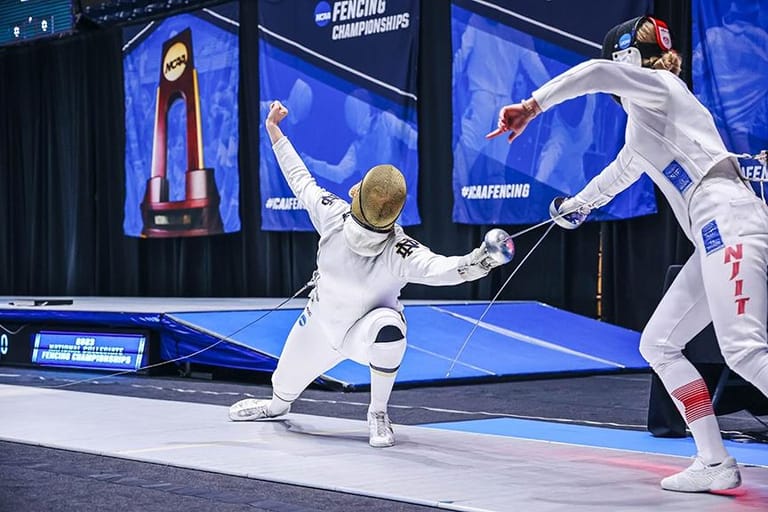
45 Schools Sponsor NCAA Fencing. Most Families Never Hear About Them.
Boulder's premier épée academy has built college athletes for 47 years, and we've mapped every step of the pathway.
All equipment provided. No experience necessary.
47
Years building college athletes
24
NCAA title slots per weapon
28
Division I programs
45
NCAA schools sponsor fencing
Is fencing good for college admissions?
Yes. Recruited athletes are admitted to highly selective schools at rates well above the general applicant pool: published research on elite university admissions has put the recruited-athlete advantage at roughly four times the odds of a comparable non-athlete, and figures released in the Harvard admissions litigation showed a larger gap still. Fencing compounds that in a specific way. It is sponsored by only about 45 NCAA schools, many of them among the most selective in the country, so the pool of athletes a coach is choosing from is small in a way that soccer or basketball never is. NCF Boulder's recruitment-track curriculum (the Competitive tier) is the on-ramp; recruiting contact typically begins in 9th-10th grade.
Weapon choice narrows the pool further. College rosters carry all three weapons in rough balance, and NCAA championship slots are allocated evenly at 24 per weapon per gender, so a coach filling an epee line is choosing from epee fencers specifically, not from fencers generally. NCF Boulder is an epee-only club, which means every athlete who progresses through the tier ladder is training for a weapon-specific recruiting slot.
The Numbers Behind the Pathway
NCAA fencing is small, and the scarcity is the argument. Forty-five schools sponsor the sport, their rosters hold roughly 1,400 fencers across all four class years, and the freshman seats opening nationally each fall number in the low hundreds. A coach filling an épée line is choosing from a pool that would fit inside one gymnasium.
That scarcity is what puts a fencer in front of an admissions committee with a coach's support attached. The clearest public evidence of what coach support is worth comes from the Harvard admissions litigation. Six years of internal data covering the classes admitted from 2014 through 2019 showed recruited athletes admitted at 86%, more than 14 times the rate for applicants who were not recruited athletes. Recruited athletes made up under 1% of Harvard's applicant pool and more than 10% of its admitted class.
Two limits on that figure are worth stating plainly. It describes one university, and it is a raw admit rate for athletes a coach had already selected, so what it measures is the value of the coach's slot. Broader research on selective private universities has put the recruited-athlete advantage at roughly four times the odds of a comparable non-athlete, and a 2023 study of twelve Ivy-Plus colleges attributed about a quarter of the admissions advantage held by top-income applicants to athletic recruitment.
The Ivy League awards no athletic scholarship money and other programs award partial amounts, so for most families the admission itself is the return.
How College Fencing Recruiting Actually Works
College fencing recruiting operates on a different timeline than most sports. Coaches identify prospects early, and athletes who understand the timeline have a significant advantage.
Sophomore Year: Get Visible
- Compete in at least one USFA regional tournament
- Begin building a competitive record with national points
- Create a basic athletic profile (ranking, coach reference, academics)
- Research programs matching your athletic and academic profile
Junior Year: Make Contact
- Reach out to college coaches directly (NCAA rules permit this)
- Send recruiting videos: épée technique, footwork, tournament footage
- Attend college fencing camps for in-person evaluation
- Request unofficial visits to top-choice programs
Senior Year: Commit
- Official visits and scholarship discussions
- NCAA timeline for early decision and regular admission
- Final competitive season results matter. Maintain your ranking
Why Your Child's Weapon Choice Matters
Recruiting in fencing happens weapon by weapon. College rosters carry épée, foil, and sabre in rough balance, and the NCAA allocates championship slots evenly across them: 24 per weapon, per gender. A coach with an épée line to fill is choosing from épée fencers, not from the whole sport. At NCF Boulder, we specialize in épée. Every element of our curriculum is designed around one weapon and the roster slots that come with it.
Where Fencers Go to College
Division I Programs (28 schools)
Division II
1 school
Wayne State UniversityDivision III Programs (16 schools)
College Pathway Support, Built In
NCF Boulder doesn't just train athletes. We provide the infrastructure competitive families need to navigate college recruitment.
Quarterly College Prep Seminars
Recruiting timeline workshops for Development and Competitive athletes and families. What coaches look for, how to make contact, how to read a scholarship offer.
Fencing Resume Development
Competition record, rankings, academic profile, coach statement. Formatted for NCAA recruiting standards.
Recruiting Timeline Guidance
From first tournament entry to signing day, we help families understand where their athlete stands and what comes next.
Coach Introduction Facilitation
Where appropriate, we facilitate warm introductions between NCF Boulder Development and Competitive athletes and college coaches we have relationships with.
NCF Boulder's Track Record
NCF head coach Gary Copeland has produced 64 Junior and Cadet World Championship and Pan American team selections, the level of competitive results that drive college recruitment.
Our alumni include Jasmine McGlade, who was the #1 ranked US women's epee fencer (Junior/Cadet), a two-time Junior World Team member, and a Harvard fencer who earned NCAA team champion and individual All-American honors. She returned from a 10-year retirement in 2024 and immediately won the 2025 Vet-40 national title, qualifying for the World Team.
In 2025, current NCF youth fencer Maddie Burks won a Pan American silver medal in Youth Women's Epee, the kind of international result that puts a fencer on every college coach's radar.
Verified NCF Boulder Alumni University Placements
What About the "1 in 3 Fencers Fence in College" Number?
You will see a claim online that roughly a third of high school fencers go on to compete in college, usually printed beside single-digit rates for soccer and basketball. The arithmetic behind it is real. The conclusion it invites is wrong, and it is worth walking through why.
The NCAA publishes an estimated probability of competing in college athletics for fifteen high school sports. Fencing is not one of them, because the high school participation data is too thin to support the calculation. In the 2022-23 national federation survey, high school fencing existed in four states, across 118 boys' programs and 118 girls' programs, with 4,120 athletes in total. Set roughly 1,400 NCAA roster spots against a denominator that size and you get a spectacular-looking conversion rate.
The denominator is the problem. Almost every American fencer who reaches a college roster came up through a private club, and none of those athletes appear in the four-state survey. The honest version of the claim is structural. NCAA fencing has few programs, those programs sit at highly selective schools, and each roster is filled weapon by weapon. That is a real advantage, and it stands without an inflated percentage attached to it.
Sources
- School and roster counts: USA Fencing, NCAA Fencing (45 sponsoring schools, August 2024) and the USFCA's NCAA fencing overview (1,384 student-athletes, 719 women and 665 men, 2023-24).
- Championship slots: NCAA men's and women's fencing pre-championships manual, 144 qualifiers at 24 per weapon per gender.
- Harvard admit rates: Arcidiacono, Kinsler, and Ransom, "Legacy and Athlete Preferences at Harvard" (NBER Working Paper 26316; Journal of Labor Economics, 2022), domestic applicants, admissions cycles 2014-2019.
- Recruited-athlete advantage at selective privates: Espenshade and Chung, "The Opportunity Cost of Admission Preferences at Elite Universities" (2005), and Chetty, Deming, and Friedman, "Diversifying Society's Leaders?" (NBER Working Paper 31492, 2023).
- High school participation: NFHS 2022-23 High School Athletics Participation Survey, fencing sanctioned in 4 states.
Frequently Asked Questions
When should my child start fencing if the goal is college recruiting?
Earlier is better, but "early" is relative to the pathway, not just age. A child who starts at 12 with consistent, high-quality coaching can reach a recruitable level by junior or senior year. A child who starts at 8 has more runway. What matters is stage progression: reaching Development or Competitive level, accumulating national points, and engaging the recruiting process proactively.
What about scholarships? Is there real money available?
Yes, though it is important to understand the shape of it. Fencing is an NCAA equivalency sport, not a headcount sport: a Division I program can award roughly 4.5 scholarships on the men's side and 5 on the women's, divided across a roster that often runs 24 or more athletes. Full rides are rare; partial awards are the norm, and not every program funds to the NCAA limit. Ivy League programs award no athletic scholarships at all, but they do offer need-based aid, and recruited athletes receive meaningful preference in admissions.
Does my child need to be nationally ranked to get recruited?
Not necessarily. While top D1 programs pursue nationally-ranked athletes, many strong D3 and mid-major D1 programs recruit athletes with solid regional records and good academic profiles. The key is identifying programs that match your athlete's competitive level, something we help Development and Competitive athletes navigate.
Why do college programs recruit épée fencers specifically?
Épée is the only weapon with no right-of-way rule and a whole-body target, which makes it the most accessible weapon to develop. College rosters carry all three weapons, and NCAA championship slots are allocated evenly across them at 24 per weapon per gender, so every program needs épée fencers. That means a strong épée fencer competes for a limited, weapon-specific set of recruiting slots rather than a slice of an undifferentiated pool. NCF Boulder specializes in épée.
Is there an Ivy League connection to fencing?
Yes. 7 of 8 Ivy League schools have active NCAA fencing programs. Fencing athletes frequently gain admission to highly selective schools. The academic profile of the typical competitive fencer (disciplined, strategic, intellectually engaged) correlates with selective admissions criteria.
Start Your Pathway Today
Your child doesn't need to be a recruit today. They need a first class, a qualified coach, and a progression system built to get them there.