Every parent of a child with ADHD has had a version of the same conversation with the soccer coach, the basketball coach, the baseball coach. “Great kid. Bright kid. Just has trouble paying attention during practice.” You drive home with a polite smile and the same private thought: my child does not fit here.
The problem usually is not your child. It is the structure.
Most youth sports are built for a narrow band of attention: long stretches of waiting, brief moments of action, group-paced instruction, and feedback that arrives hours after the play. That format works well for some kids and works against ADHD wiring on every dimension. Fencing is built the opposite way. That is why it shows up so often in the lists parents pass to each other when soccer has failed for the third time.
Why Most Sports Don’t Fit ADHD Kids
Walk through a typical youth practice and count the demands the format places on attention:
- Bench time and waiting your turn. Outfield in baseball. Sideline in basketball. Substitution rotations in soccer. Children with ADHD do not lose attention because they are bored. They lose attention because there is nothing to react to.
- Group-paced instruction. Coaches teach to the middle of the group. Children who process faster than the group disengage. Children who process differently get lost. Either way, the verbal-lecture format is the hardest channel for an ADHD brain.
- Delayed feedback. The mistake happens in the third inning. The coaching note comes in the car at 8 p.m. The link between action and feedback is broken.
- Diffused accountability. A pass goes nowhere, a play breaks down, and ten kids share the result. There is no clean loop from “what I did” to “what happened next.”
None of this is a coaching failure. It is a structural mismatch. The kids leave practice frustrated, the parents leave practice frustrated, and the cycle of trying-the-next-sport begins.
What the Research Says About Exercise and ADHD
The clinical literature on exercise and ADHD is unusually consistent. A 2021 meta-analysis in the International Journal of Behavioral Nutrition and Physical Activity covering randomized trials in children with ADHD found that exercise interventions produced moderate-to-large improvements in executive function (standardized mean difference 0.61), with the strongest effects on inhibitory control (0.76) and cognitive flexibility (0.78). Typical protocols ran 6 to 12 weeks, 3 sessions per week, 45 to 90 minutes per session.
A 2024 meta-analysis sharpened the picture further. When researchers separated “open-skill” sports (those requiring real-time reactions to a changing environment, like an opponent) from “closed-skill” sports (those with a fixed environment, like running or swimming), open-skill activities produced superior effects on executive function in ADHD children.
That distinction is the whole game. Fencing is the prototypical open-skill sport. Every action on the strip is a response to a live human opponent. There is no rehearsed play. There is no choreography. You are reading distance, timing, and intent in real time, and adjusting before the next exchange. The cognitive demand is the activity.
This is not a claim that fencing treats ADHD. It is the simpler claim that fencing, by design, looks almost exactly like the exercise protocol the research recommends.
How the Fencing Structure Actually Works
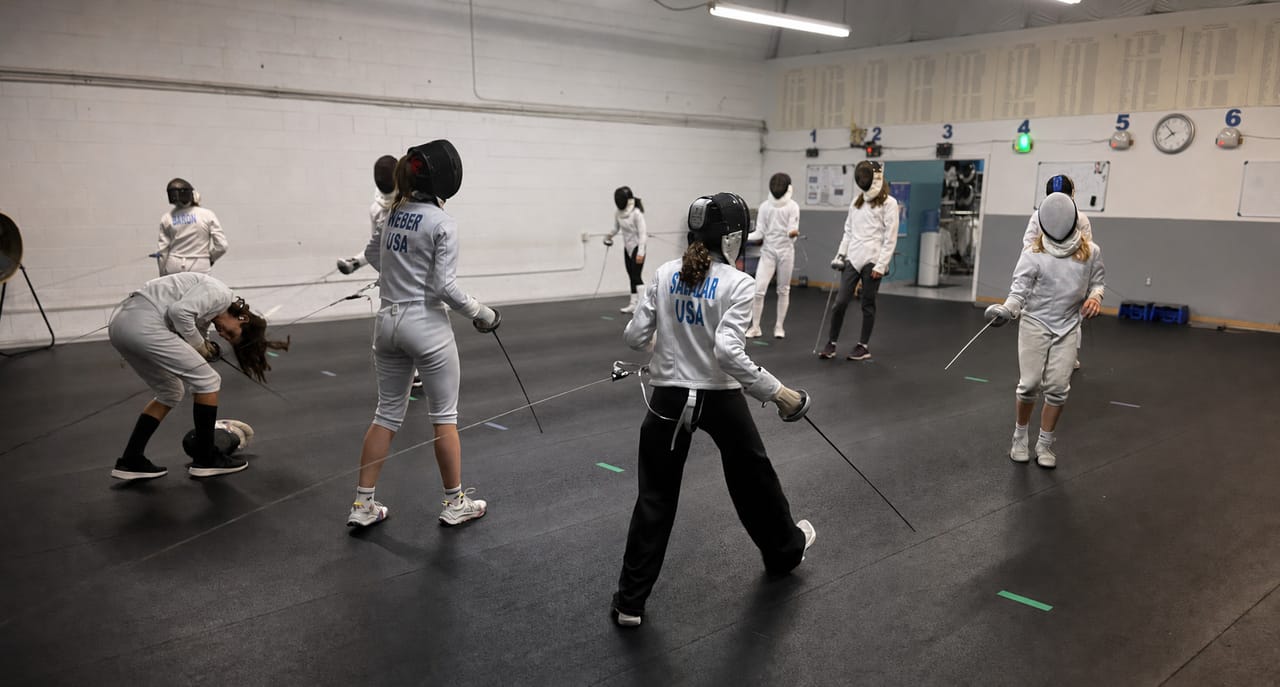
Here is what a youth fencing class at NCF Boulder looks like, mapped against the things ADHD brains need:
Short, varied drills. A class moves through warm-up footwork, partner blade drills, coach-led tactical patterns, and structured bouting. No single block runs long enough for attention to fade.
Immediate feedback on every action. Every touch in fencing is scored. Every lunge connects or misses. Every parry works or does not. The loop between action and consequence is measured in seconds. There is no lag.
Continuous physical engagement. There is no bench, no outfield, no waiting in line. From the first salute to the last, your child is in motion. The energy that gets a kid in trouble at school becomes the resource the sport asks for.
Clear rules, clear space. The strip is 14 meters long and 1.5 to 2 meters wide. The rules are explicit. Boundaries are unambiguous. For children who struggle with ambiguity and improvised social norms, this is a relief.
One-on-one accountability. When you are on the strip, you are the only person on the strip. There is no teammate to blame, but there is also no teammate to disappoint. The cognitive load drops to the work in front of you.
This is not a curriculum we designed for ADHD. It is the structure of the sport. It just happens to map onto how a lot of these kids think.
The 3-Second Reset
One piece of the NCF Boulder Mindset curriculum is worth flagging here because it lands particularly well with ADHD athletes.
After every touch, there is a moment when a fencer either rehearses the mistake or moves on. The 3-Second Reset is a trained habit: acknowledge what happened, reset stance and breath, re-engage with the next action. We teach it explicitly, drill it during practice, and reinforce it during bouting.
Children who learn to reset on the strip start using the same habit elsewhere. Parents tend to notice it in homework first, then in arguments with siblings, then in recovering from a bad moment at school. We do not promise that result; we observe it.
What NCF Boulder Adds to the Format
Several specifics matter beyond the sport itself.
Head coach Gary Copeland is a US Olympic Committee Coach of the Year with 47 years of experience training youth athletes. He has been doing this since long before “executive function” was a parenting vocabulary word. The patterns that work for ADHD kids in his classes have been refined over decades, not adapted from a marketing brief.
Group classes cap at 8:1 to keep coach attention high and waiting low. Weekly private lessons give each athlete dedicated one-on-one work, which is where mental habits get installed. Equipment is provided and fitted on-site, so the first day is about the sport, not about a shopping trip.
NCF Boulder is also Boulder’s only epee-specialist program. Epee is the simplest of the three fencing weapons to learn quickly: the whole body is a valid target, the rules are intuitive, and there is no subjective right-of-way call to argue. That matters when you are trying to keep a frustration-prone athlete in the loop.
A Note on What This Post Is Not
This is not a clinical recommendation. ADHD is a real diagnosis with real treatment protocols, and decisions about medication, therapy, and educational support belong to families and their clinicians. What we can offer is a sport whose structure happens to match the exercise interventions the research recommends, run by coaches who have been working with attention-different kids for decades.
If you have already tried two sports and watched the same pattern unfold, the next reasonable experiment is a sport built differently. Come find out whether this is the one that fits.
All equipment provided. No experience necessary.
Book your first lesson at NCF Boulder - one hour with the coaching staff, gear fitted on-site, no charge - and see how the structure works for your child. Learn more about our youth fencing program or how epee is different.