Every year, admissions officers at selective colleges read thousands of applications from strong students who look almost identical on paper. Good grades. A few AP classes. Varsity soccer or basketball, plus a club or two.
If your child is one of those students, the hard question is not whether the application is good. It is whether anyone reading it will remember it an hour later.
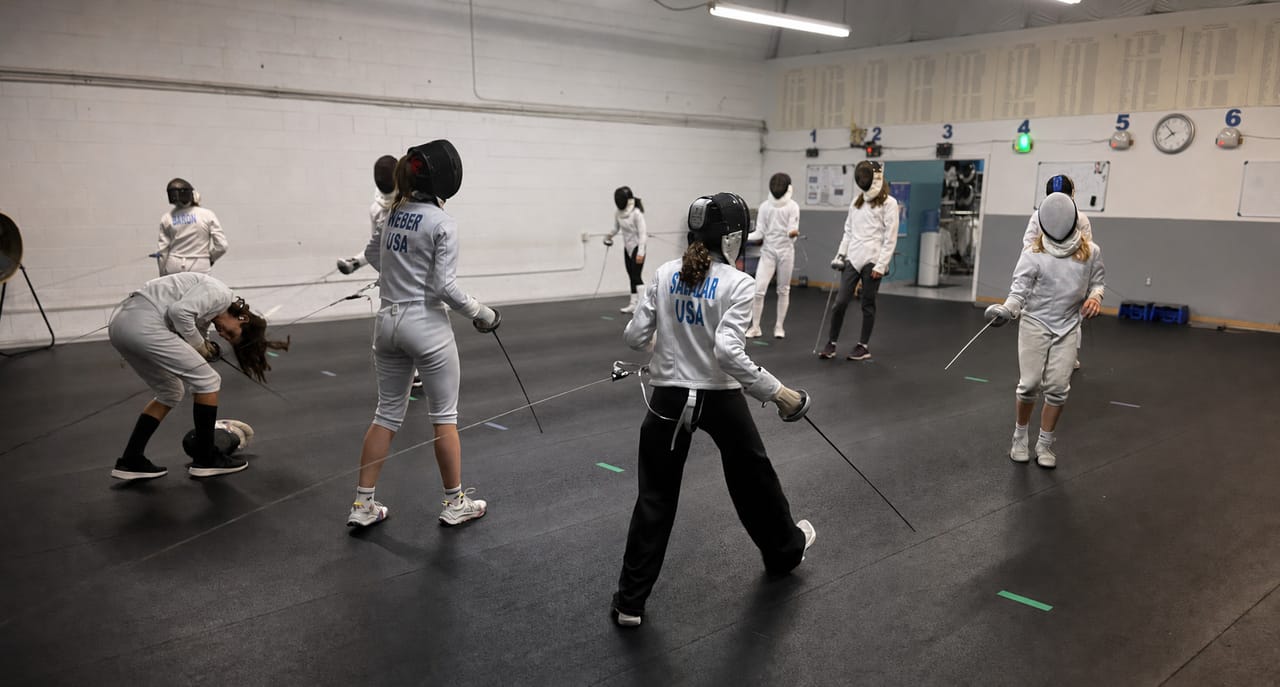
A rare, demanding sport is one of the few things on a teenager’s application that a reader has not already seen a hundred times that same week. Admissions officers see thousands of soccer players. Fencers stand out, and the reasons go deeper than novelty.
Why strong students blur together
Selective admissions is a comparison exercise. A reader is not asking whether your child is impressive in isolation. They are asking how your child compares to the several hundred other applicants who look a lot like them, from similar schools, with similar grades and similar activities.
Most extracurriculars pull a student into a very large comparison group. That is where a common sport works against an applicant. When an activity is everywhere, being good at it says less, because the reader has a huge sample to measure against.
The way to be memorable is to compete in a smaller, more distinct pool. Fencing does exactly that.
Popular sports rarely set an application apart
Soccer, basketball, and baseball are excellent for kids. They build fitness, teamwork, and grit, and no parent should pull a child from a sport they love. As an admissions differentiator, though, the popular sports carry a structural problem.
Millions of kids play them. An admissions officer at a selective school might read hundreds of varsity soccer players in a single cycle. Colleges recruit a tiny fraction of those athletes, usually the top sliver of a percent nationally, so for almost every family the popular-sport path offers long odds and little separation.
The issue is not the quality of the sport. It is the size of the crowd standing in the same line as your child.
Fencing puts your child in a smaller pool
Competitive fencing is a fraction of the size of youth soccer or basketball. Far fewer kids fence seriously, and the colleges that sponsor fencing still need to fill their rosters every year. A small pool of athletes and a steady demand for recruits produce a recruit-to-applicant ratio that the popular sports cannot match.
The structure of the sport shows it plainly. Fencing is sponsored by 45 NCAA schools, and the national pool of competitive junior fencers is small enough that a coach filling a roster is choosing from hundreds, not tens of thousands. Set that against soccer or basketball, where the low single-digit odds are a matter of sheer volume, and the difference in a family’s realistic chances is large.
We walked through this math in more detail in Fencing vs. Climbing: The NCAA Advantage Parents Miss, where the same pattern shows up against another popular Boulder activity.
The NCAA numbers behind the pathway
Fencing is a varsity NCAA sport with a real recruiting pipeline. There are 28 NCAA Division I fencing programs and about 45 programs across all three NCAA divisions. That list includes many of the most selective schools in the country: Harvard, Princeton, Columbia, Penn, Duke, Notre Dame, MIT, and Stanford among them.
Epee, the weapon we specialize in at NCF Boulder, accounts for roughly 64 percent of college fencing recruitment. A child who trains epee seriously is developing toward the largest share of available college spots in the sport.
You can see the full list of programs and how the recruiting timeline unfolds on our NCAA fencing pathway page.
What years of fencing signal to admissions
The roster spot is only part of the value. Even for a student who never gets recruited, a long commitment to fencing tells an admissions reader something specific about the person behind the application.
It signals strategy. Epee is a chess match at speed, and sticking with it for years shows a mind that plans, adapts, and competes under real pressure.
It signals discipline. Progress in fencing is slow and measured, so a student who has trained for years has demonstrated the sustained, self-directed effort that predicts how they will handle college.
It signals independence. Fencing is an individual sport, where wins and losses belong to the fencer alone. Admissions readers understand what that kind of accountability asks of a teenager.
Those signals sit on top of academics, which remain the foundation of any competitive application. A rare sport is the differentiator that makes a strong record memorable.
At NCF Boulder, we specialize in epee fencing for athletes ages 7 and up. Our program is led by Gary Copeland, a US Olympic Committee Fencing Coach of the Year, with 47 years of experience and 46 national champions produced. We develop young athletes from their first lesson through college recruitment.
All equipment provided. No experience necessary.
Book your first lesson - one hour with the coaching staff, gear fitted on-site, no charge. Or explore the NCAA fencing pathway to see how epee athletes get recruited.
Frequently Asked Questions
What if my child isn’t good enough to be recruited?
Most fencers are not recruited athletes, and that is fine. A rare, demanding sport still sets an application apart and signals strategy, discipline, and years of commitment to an admissions reader, whether or not a college coach ever calls. The skills and the story hold their value on their own, on top of a strong academic record.
Which colleges have fencing teams?
There are 28 NCAA Division I fencing programs and about 45 across all three divisions, including Harvard, Princeton, Columbia, Penn, Duke, Notre Dame, MIT, and Stanford. Our NCAA fencing pathway page lists the programs and walks through how the recruiting timeline works.
Isn’t it too late to start for college?
Starting between ages 10 and 12 gives a fencer the most runway to develop and enter the recruiting pipeline. Starting later is still workable, though the timeline is more compressed. The sooner a committed athlete begins, the more college options stay open.
Does a unique sport matter more than grades?
No. Academics come first, and a strong record is the foundation of any competitive application. A rare extracurricular like fencing is a differentiator that strengthens an application already built on good grades.